PIVTR-D
A field manual for incident responders.
Incident running now?Start here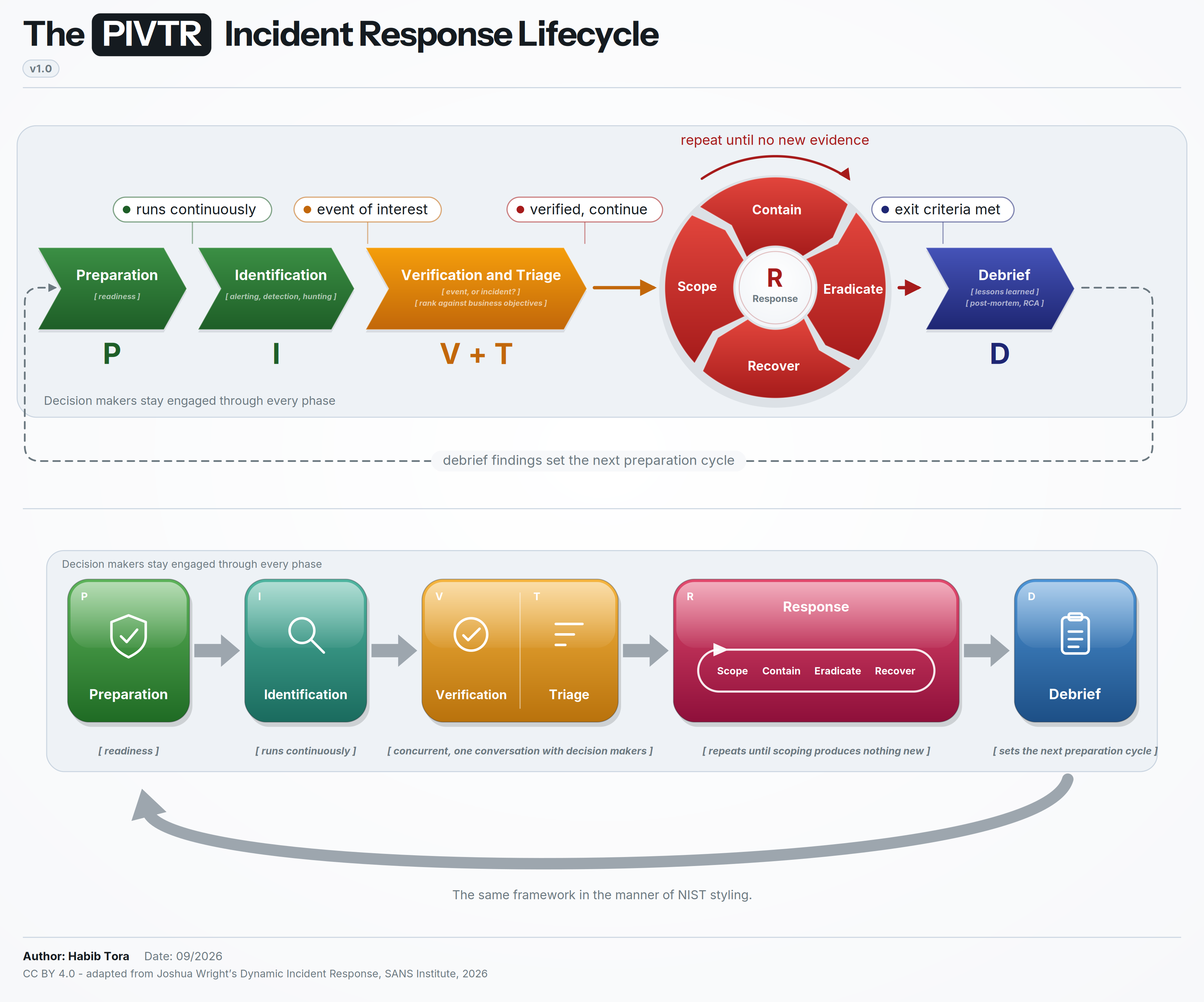
The model and most of the checklists are taken straight from Joshua Wright's updated incident response book and condensed into a short field guide for incident responders. It covers the lifecycle, the decisions that go with it, and the records the after-action review will need.
Find the phase you are in and go to its playbook. Each one says what starts the phase, what finishes it, what record it leaves behind, and what to check along the way. Decide these before the incident lists the decisions that should already have been made, so look there before improvising one at speed. The lifecycle orients anyone who walks onto the bridge halfway through.
Three sets of pages add to the phase playbooks. Scenarios cover what happened, in 13 kinds of incident from ransomware to denial of service. Sectors cover who you are: the reporting clocks, terms and roles of eight sectors: federal civilian agencies, defense, healthcare, financial services, energy and water utilities, transportation, state and local government, and education. Cloud playbooks give the commands for 22 incident types on AWS, Azure, Google Cloud and Oracle Cloud. The 19 record templates, evidence collection and metrics round it out.
PIVTR-D covers what responders do. The companion guide, Incident Command, covers who decides, how the response is organized, and how it runs past the first night.
The source book is free to read and download at dynamicincidentresponse.com, and SANS has its own page for it at sans.org/engage/dynamic-incident-response.